

Knowledge Centre
Our knowledge centre is your go-to source for engineering knowledge. Dive into expert articles, project highlights, and industry trends that reflect our commitment to continuous learning and innovation in process equipment.
Newsletter
 Aug 26
PECPL Rod Baffle Heat Exchangers: Novolen & Scientific...
 May 26
 Performance Enhancement of Heat Exchanger Tube by...
 Nov 25
 Transforming Heat Exchanger Performance in Refineries
 July 25
 Procedure Qualification of Grade 5 Welds with LAS
 Jan 25
 Fabrication of Critical Heat Exchangers Involving Ferric
 Aug 24
 CO2 Reduction Solutions
 Jul 24
 Grade 9 Pressure Vessel
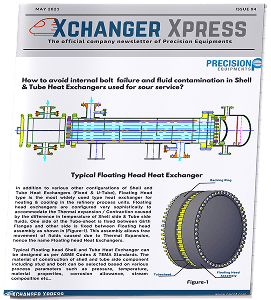 May 21
 Shell and Tube Heat Exchangers
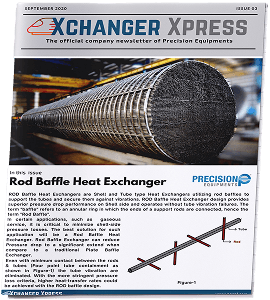 Sept 20
 Rod Baffle Heat Exchangers
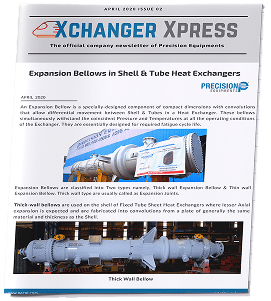 Apr 20
 Expansion Bellows in Shell & Tube Heat Exchangers
Frequently Asked Questions
Find answers to commonly asked questions about our products, processes, capabilities, and services. Whether you’re a customer or collaborator, our FAQs aim to provide clarity and assist your decision-making.
What is PCC 1 and is it mandatory?
ASME PCC-1 has guidelines for pressure boundary bolted flange joints which cover the assembly elements that are essential in ensuring a high level of leak-tightness integrity of properly designed and constructed bolted flange joint assemblies (BFJAs).
Specifically, this standard defines BFJAs as those applied to pressure-boundary flange joints with ring-type gaskets that are entirely within the circle enclosed by the bolt holes and have no contact outside this circle.
ASME PCC-1 is not mandatory as per ASME Sec. VIII Div.1 code and is generally considered an additional project-specific requirement insisted by the client.
What are the maximum temperature limits for Super Duplex Stainless Steel (SDSS), Stainless Steel (SS), Carbon Steel (CS), Titanium, and Inconel?
The maximum temperature limits for the materials are as follows:
• Super Duplex Stainless Steel (SDSS): 300–350°C (572–662°F)
• Stainless Steel (SS): 800–900°C (1472–1652°F)
• Carbon Steel (CS): 400–600°C (752–1112°F)
• Titanium: 600°C (1112°F)
• Inconel: 1000°C (1832°F)
These limits vary depending on the specific alloy and operating conditions.